
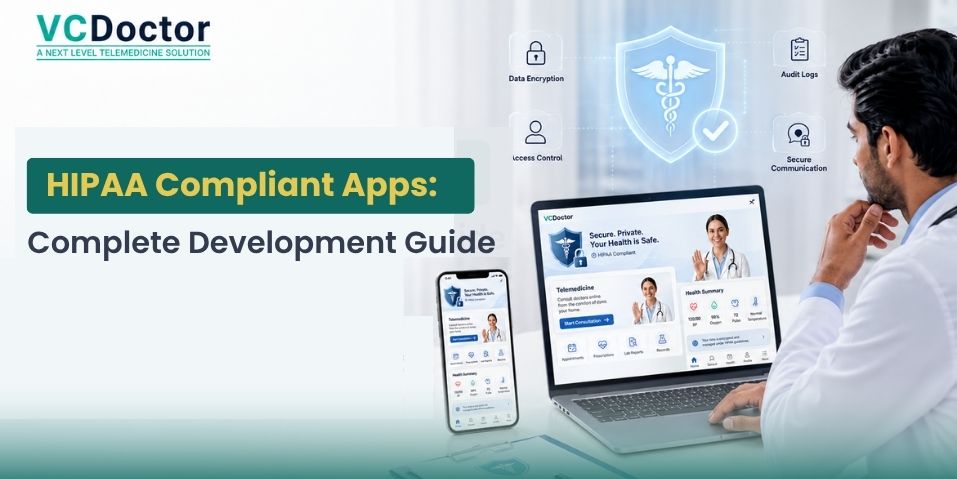
HIPAA Compliant Apps: Complete Development Guide
In the healthcare industry, HIPAA compliant apps are a must. HIPAA is the most important piece of legislation for anyone looking to create healthcare-related applications or software for the U.S. market.
Healthcare mobile app development is revolutionizing at a faster pace. Therefore, almost every healthcare IT solution provider is giving importance to this scope. In this world of digitalization, healthcare service providers and their partners are investing in modern and advanced solutions to stay ahead of the competition. Different healthcare providers meet the standards of HIPAA-compliant healthcare applications for their solutions.
In the era in which we live now, it isn’t easy to keep data secure. If we look at any industry that deals with user data, we will undoubtedly see some correspondence that makes the industry more secure.
The healthcare sector, too, needs strict compliance to save users’ data from misuse in the current mobile age. Although compliance varies from country to country, HIPAA- Health Insurance Portability and Accountability Act has become universal for many reasons.
In this Blog, we give you a basic overview of the process of creating HIPAA applications to help launch your digital transformation journey.
What are HIPAA-Compliant Apps?
Healthcare and insurance companies are widely using smartphones and wearable devices. These devices help hospitals connect doctors with patients and virtually monitor their health. Smartphone apps that process, receive, or send private data in any manner must comply with HIPAA. Therefore, HIPAA-compliant apps are currently a popular type of development.
HIPAA ensures that there are no deviations in the handling and storage of patient data. It also covers information sharing, billing, and citizens’ health insurance.
The Health Insurance Portability and Accountability Act (HIPAA) was introduced in 1996 to regulate user/patient data protection, reduce healthcare costs and protect health insurance for those who lose their jobs or change jobs. Healthcare service providers must follow HIPAA-compliant rules and regulations when working on application development.
One of the main goals of HIPAA is to provide insurance coverage and maintenance. It also covers areas such as administrative simplification. HIPAA also covers provisions related to the taxation of medical expenses.
Therefore, if you need to develop a Healthcare mobile app, your product must be HIPAA compliant. HIPAA-compliant apps ensure the privacy and security of patient information and control health insurance restrictions.
Types of Healthcare Data Domains
When developing a healthcare application for the U.S. market, you first need to find out what information you store and transmit through your application. There are two types of information:
PHI (Protected Health Information)
It includes doctors’ bills, emails, MRI scans, blood test results, and other medical information.
CHI (Consumer Health Information)
It contains information that you receive from your fitness monitors, such as the number of calories burned, heart rate readings, and the number of steps you walk.
So, if your app or software processes, stores, or transmits any PHI data, then it must undoubtedly be HIPAA compliant.
Even if you want to create an app or software for other countries or regions, you will still have to meet the country’s requirements. Almost every country has its legislation governing the use of private medical data.
How Do HIPAA-Compliant Apps Work?
In terms of compliance, HIPAA has two main aspects that are mentioned below.
HIPAA Privacy Rule: It codifies the types of data that make up Protected Health Information (PHI).
HIPAA Security Rule: It describes the responsibilities of each organization that manages electronically protected health information (ePHI).
All healthcare organizations that process ePHI are covered entities, which means they must follow HIPAA rules.
Read Also: The Top 10 HIPAA-Compliant Telehealth Platforms
Planning a HIPAA-Compliant Healthcare App?
Get expert guidance on HIPAA requirements, secure architecture, and the right development approach for your app.
Schedule a Free ConsultationWhy are HIPAA-compliant Apps Important?
The HIPAA Regulation is a comprehensive law established to assist both healthcare organizations and patients. Therefore, when creating HIPAA-compliant apps, it is necessary to know why it is important.
For Patients
HIPAA is very important as it forces health plans, service for providers, business associations of the entities covered, and clearinghouses to implement specific safeguards to protect sensitive health and personal data.
While no medical organization wants health information stolen or sensitive information disclosed, there would be no way to force the healthcare industry to protect data without HIPAA. In particular, HIPAA protects patients and their data. Criminals may use personal data and private medical information against patients.
HIPAA protects patients from identity theft, a widespread crime related to personal data fraud. Identity theft can lead to large debts, significant financial losses, and harmful counterfeit claims for a person. No one can pass on patient information without their consent, so HIPAA helps ensure that all information disclosed to health plans and providers or information created, stored, or transmitted is subject to strict security measures.
Entities should inform patients of the breach as patients are fully entitled to their medical data. This enables smooth data exchange between several healthcare institutions. Even with the utmost compliance and care, medical organizations can make mistakes when storing or using health information. If patients can obtain copies, they should check for errors and make sure they correct them.
Before the invention of the HIPAA Privacy Policy, organizations were not required to share and publish copies of PHI with patients.
For Organizations
HIPAA helps organizations strengthen healthcare management by ensuring the secure handling and transmission of PHI while supporting privacy and security across healthcare operations.
If a company does not comply with HIPAA requirements, they face civil penalties structured across four tiers based on the level of culpability — ranging from $145 per violation for unknowing violations up to $2,190,294 per violation for willful, uncorrected neglect, with a statutory annual cap of $2,190,294 per identical violation category, per calendar year. Criminal violations are handled separately and can carry additional fines of up to $250,000 along with imprisonment of up to 10 years. These figures are adjusted annually for inflation by HHS, so always confirm current amounts on hhs.gov before publishing.
HIPAA’s standardization requirements for electronic transactions, code sets, and identifiers promote consistency and interoperability among healthcare providers, health plans, and other covered entities. Because all HIPAA-covered entities must use the same nationally recognized identifiers and code sets, this ensures the secure transmission of EHI between health plans, providers, and other entities.
Read Also: A Comprehensive Guide to HIPAA Compliant Telehealth Platform
Key Features of HIPAA Compliant Apps
When you decide HIPAA Compliant app development, you must know that the features may differ significantly for patients, providers, and clinics. Let us see the features of HIPAA Compliant apps for patients, doctors, and hospitals.
| Patient | Doctor/ Provider | Hospital/ Clinic |
| Registration | Registration | Registration |
| Search Doctor | Schedule Management | White-label Solution |
| Appointment Booking | Manage Appointments | On-board Doctors and Staffs |
| Appointment Confirmation | Consultation with Patients | Patient’s Information Management |
| Consultation with Doctor | Provide ePrescription | Consultation with Patients |
| ePrescription | Integration of Pharmacies and Labs | Set up Pharmacies and Labs |
| Share Feedback | Payment and Refund Management | Brand Awareness |
How to Build HIPAA Compliant Apps
Step 1: Find an Expert
Do not try to meet all HIPAA requirements if you do not have enough experience. So, it is better to take advice from an expert who has years of experience. You can choose the best healthcare app development company or outsource the entire HIPAA-compliant application development process to an experienced team. But it is highly recommended to choose experts from the telemedicine software company, as it is beneficial for start-ups and large healthcare companies.
Step 2: Evaluate Patient Data
Ensure you need all the data you collect from patients and determine what data can be classified as PHI. Check which PHI data can be avoided from being saved or transmitted through your mobile app from the collected data.
Step 3: Find Already HIPAA-Compliant Third-party Solutions
Getting custom HIPAA mobile apps from scratch can be costly. So it is better to go with white-label solutions. Such third-party solutions save time, money, and effort, and this is called IaaS (Infrastructure as a Service).
To use a third-party service to store or manage PHI data, you must sign a business associate agreement with the third-party companies to ensure trustworthiness. If you use high-quality third-party solutions, you have to worry about creating something that isn’t present in the solution.
To help you out with this step, we bring VCDoctor, a white-label telemedicine solution that can be customized according to your business. To know more in detail, request a free demo today!
Step 4: Conduct a Security Risk Assessment (SRA)
Before writing a single line of code, conduct a formal Security Risk Assessment to identify where PHI will be created, received, maintained, or transmitted, and what vulnerabilities exist at each point. The SRA is not optional — it’s the single most commonly cited deficiency in HHS OCR enforcement actions, and it forms the foundation every other compliance decision is built on.
Step 5: Appoint a Privacy Officer and Security Officer
HIPAA requires every covered entity and business associate to designate a Privacy Officer (responsible for policies around PHI use and disclosure) and a Security Officer (responsible for technical and administrative safeguards). For smaller teams, one person can hold both roles, but the responsibility must be formally assigned — not assumed.
Step 6: Train Your Team
Every employee or contractor who may come into contact with PHI — including developers, support staff, and QA testers — needs HIPAA awareness training before go-live, and refreshers at least annually. Untrained staff handling test data or production PHI is a common, avoidable compliance gap.
Step 7: Encrypt Complete Stored and Transferred Data
Use best security practices to encrypt your patients’ sensitive data so that there are no security breaches. Make sure that the stored data is encrypted to protect it from theft.
Step 8: Maintain and Test the App for Security
Testing is an integral part and should be done after each update. Test your mHealth apps both statically and dynamically.
Maintenance is an ongoing process that you must perform to ensure the security of your application. Libraries, tools, and frameworks for building and securing an application are constantly being updated. After HIPAA-compliant app development, you must update the app regularly to avoid security breaches.
Step 9: Build a Breach Notification Plan
Even with strong safeguards, breaches can happen. HIPAA’s Breach Notification Rule requires covered entities to notify affected individuals, HHS, and in some cases the media, within 60 days of discovering a breach. Have a documented incident-response plan ready before launch, not after an incident occurs.
How Much Does it Cost to Build HIPAA Compliant Apps?
Compliance with HIPAA requirements for healthcare applications is mandatory for any healthcare provider using a mobile application. Several elements in HIPAA need to be considered when developing mHealth apps. These elements include security, access control, and confidentiality.
The development cost to build HIPAA compliant apps depends upon many factors that are mentioned below:
- Type of application
- Type of platform
- Technology Stack
- Front-end development
- Features
- UI/UX, etc.
These were some of the key aspects that vary the cost of HIPAA-compliant app development. Contact us for more information on the cost of developing HIPAA-compliant apps.
Ready to Build a HIPAA-Compliant App?
Our experts help you build a fully compliant healthcare app from risk assessment to deployment.
Contact Us TodayConclusion
Healthcare is fast becoming the digital industry of the future. Healthcare organizations and providers must seek the best advice and service to develop healthcare applications from experts with comprehensive compliance strategies.
Developing a HIPAA-compliant application can potentially save you time, effort, and money, while HIPAA-compliant applications can help improve the security and protection of patients’ medical records.
To save money and time, be sure to use ready-made solutions as much as possible. VCDoctor offers the best technological solutions to create healthcare platforms that increase security, privacy, and reliability. With extensive experience in developing applications and software development compliance, you can expect the best platform for your operations.
VCDoctor helps you with security issues and HIPAA compliance, so if you need a consultation or mobile development services, contact our experts and book a free consultation call.
FAQs
An app is HIPAA compliant when it meets the requirements of the HIPAA Privacy Rule and Security Rule, encrypting PHI in transit and at rest, restricting access through authentication and role-based controls, maintaining audit logs, and signing a Business Associate Agreement (BAA) with any third-party vendor that touches patient data.
Yes, if the app processes, stores, or transmits Protected Health Information (PHI) for the U.S. market. Any organization that qualifies as a “covered entity” or “business associate” under HIPAA must comply, regardless of company size.
PHI (Protected Health Information) includes medical records, lab results, and billing data tied to a specific patient, and is strictly regulated under HIPAA. CHI (Consumer Health Information) includes general wellness data like step counts or calories burned from fitness trackers, which typically falls outside HIPAA unless linked to identifiable medical records.
Yes. If you use any third-party service (cloud hosting, messaging API, analytics tool) that will handle PHI on your behalf, HIPAA requires a signed BAA with that vendor before you go live.
Non-compliance can result in civil penalties ranging from $145 to $2,190,294 per violation depending on culpability tier, with the highest tier (willful neglect, uncorrected) carrying the steepest exposure. Criminal violations can carry fines up to $250,000 and up to 10 years in prison. Figures are inflation-adjusted annually by HHS.
Cost depends on the platform (iOS/Android/web), technology stack, feature set, and whether you build custom or use a white-label solution. White-label platforms significantly reduce cost and time-to-market compared to building compliance infrastructure from scratch.